
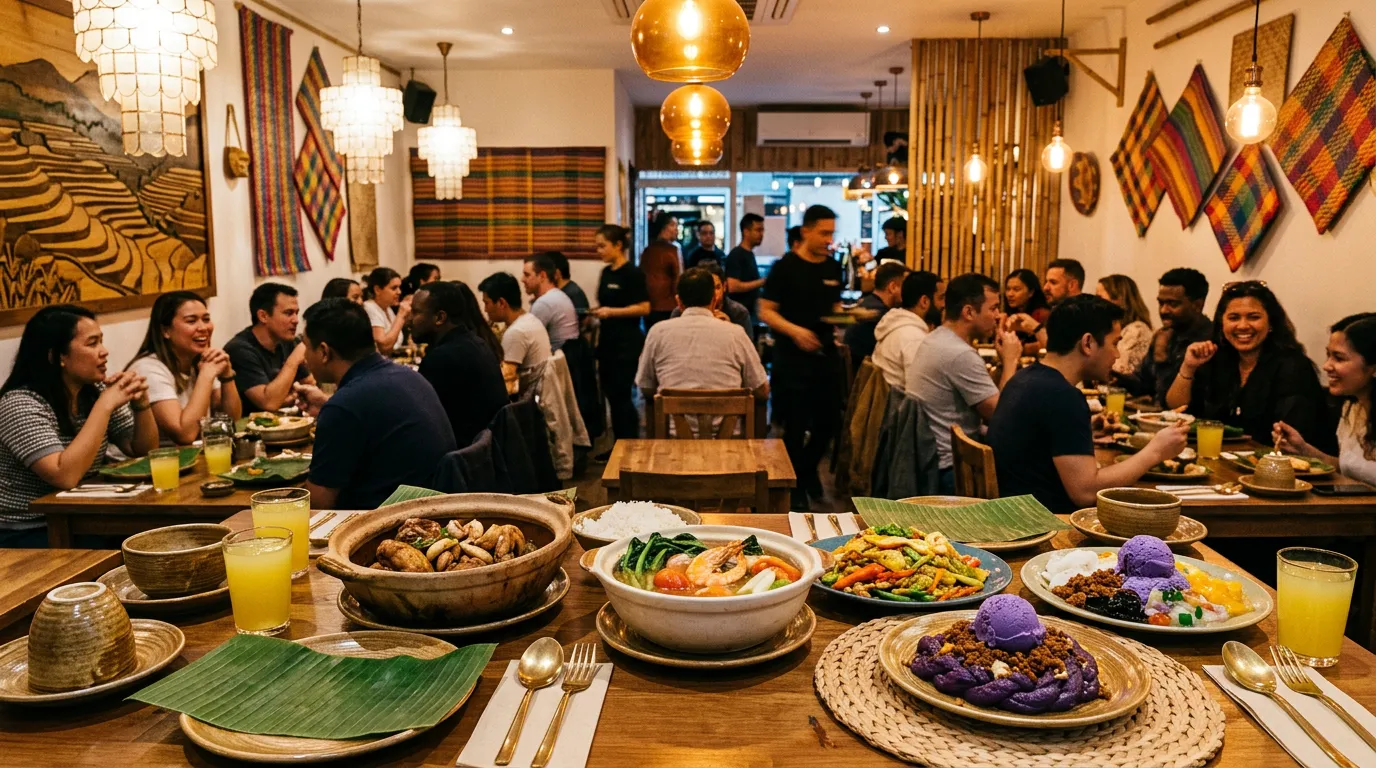
London has always been a city where the world’s food cultures arrive, take root and eventually become part of the urban fabric that Londoners consider their own. The city that made chicken tikka masala a national dish and that has embraced everything from Cantonese dim sum to West African jollof rice as part of its culinary identity is now experiencing the quiet but accelerating rise of Filipino food culture, and those who have discovered it are evangelical in their enthusiasm. Filipino cuisine, long one of the most underrepresented major Asian food traditions in the European restaurant landscape, is finding its London audience through a combination of a growing Filipino diaspora community, a generation of Filipino-British chefs who have trained in fine dining and brought those techniques to their cultural heritage, and a London dining public increasingly hungry for food cultures that feel genuinely new.
The Filipino community in London numbers in the tens of thousands, concentrated particularly in areas including Kensington and Chelsea, where Filipino domestic workers and healthcare professionals have established communities that have supported Filipino grocery stores, restaurants and social organisations for decades. This established community infrastructure is the foundation on which the current wave of Filipino culinary visibility is building, providing the supply chains, customer bases and cultural knowledge that make authentic Filipino food commercially viable in a competitive London restaurant market.
For those exploring Filipino food culture from home, the ube-based products at Ube Latte Shop offer an accessible starting point into one of the most distinctive ingredients in the Filipino pantry, with delivery across the UK allowing Londoners to experiment with ube preparations before their next Filipino restaurant visit.
The history of the Filipino community in London
Filipino migration to the United Kingdom has a history that extends back several decades, shaped initially by the demand for Filipino nurses in the National Health Service from the 1960s onward and subsequently expanded through the domestic worker visa routes that brought Filipino carers, nannies and household staff to London’s wealthier households from the 1970s through the 2000s. This migration pattern created a Filipino community in London that was from its beginning characterised by skilled, educated workers whose contribution to British society was substantial but whose cultural visibility in the mainstream was limited.
The demographic profile of the Filipino community in London has diversified significantly since the 1990s, with professionals in finance, technology, hospitality and creative industries joining the healthcare and domestic worker communities that formed the original London Filipino population. This diversification has supported the development of a more visible Filipino cultural presence in the city, with community organisations, cultural events and increasingly mainstream-accessible Filipino businesses that reflect the community’s growing confidence and economic strength.
The annual London Filipino Festival, held in various locations across the city, has grown from a small community gathering into a cultural event that attracts both the Filipino diaspora and London’s broader multicultural population, introducing lechon, adobo, halo-halo and the full range of Filipino culinary and cultural traditions to audiences who might otherwise never encounter them.
Filipino restaurants in London worth knowing
The Filipino restaurant scene in London is relatively small but punching well above its weight in terms of critical attention and culinary ambition. The most significant development of the past five years has been the emergence of Filipino-British chefs who have trained at the highest levels of European fine dining and who are now applying those skills to Filipino culinary traditions with results that are attracting serious food media attention.
Romulo Café, the London outpost of a Manila institution, brought formal Filipino dining to Kensington with a menu centred on the provincial regional cooking of the Philippines, the kind of home cooking that defines Filipino food culture outside the metropolitan restaurant context. The restaurant introduced a London dining public more familiar with Thai or Vietnamese food to the complexity of Filipino flavour profiles, built around the sour-salty-savoury balance of dishes like sinigang and kare-kare.
The Adobros, a Filipino street food operation that has operated across London’s market circuit, has brought a more casual and accessible face of Filipino food to younger London audiences, with Filipino-American influenced versions of classic dishes that translate easily for palates less familiar with the full range of Filipino flavour profiles. Their presence at major London food markets has been instrumental in introducing adobo, lumpia and sisig to a generation of London food lovers who discovered Filipino food at a street stall before seeking out restaurant experiences.
Ube and the Filipino sweet table in London
No exploration of Filipino food culture in London is complete without engaging with the extraordinary tradition of Filipino sweets, and no ingredient defines that tradition more completely than ube. The purple yam that gives Filipino desserts and celebrations their most distinctive visual signature has been known to London’s Filipino community for as long as there has been a Filipino community in London, appearing in home kitchens and community gatherings in the form of ube halaya, the dense purple jam that is the foundational Filipino ube preparation, and ube-flavoured cakes, ice creams and breads that mark Filipino celebrations.
The global social media moment of ube, driven by its extraordinary visual impact on platforms where food aesthetics are central, has brought this ingredient that Filipino Londoners have always known into the awareness of the broader London food culture. Filipino bakeries and dessert spots in London now serve ube cakes, ube pandesal and ube lattes to queues that extend well beyond the Filipino community, reflecting the broader appetite among London’s food-curious population for the kind of genuinely distinctive flavour experiences that ube’s vanilla-sweet complexity delivers.
Filipino grocery shopping in London
The infrastructure that supports Filipino home cooking in London is more developed than most non-Filipinos realise. Several Filipino grocery stores in areas with established Filipino populations stock the full range of ingredients necessary for authentic Filipino cooking, from bagoong fermented shrimp paste to calamansi lime concentrate, from pandan leaves to the various dried and cured pork products that underpin so much of Filipino cuisine.
Goldies Filipino Store in Earl’s Court is one of the longest-established Filipino grocery operations in London, serving the Kensington and Chelsea Filipino community with a range of imported Filipino products including frozen prepared foods, condiments, snacks and the specialist ingredients that distinguish Filipino cooking from its Southeast Asian neighbours. The Pinoy Store in various London locations and several Filipino sections within broader Asian supermarkets across the city complete an infrastructure that allows the Filipino diaspora to maintain their food culture and that increasingly attracts non-Filipino Londoners curious to cook Filipino food at home.