
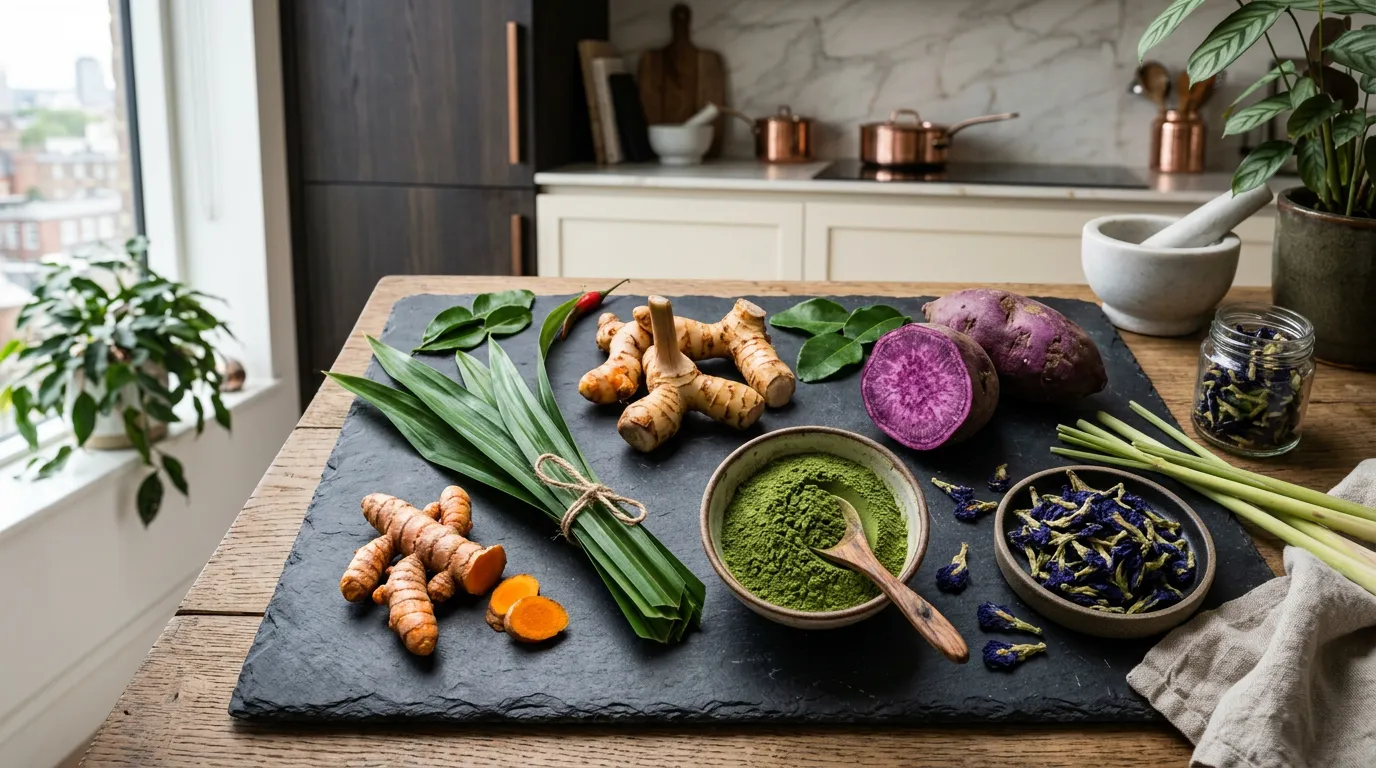
London’s food culture has always been shaped by the ingredients that arrive with diaspora communities and that gradually cross over from ethnic grocery stores to mainstream restaurant kitchens to home cooking. The journey of ginger from exotic spice to supermarket staple, of lemongrass from Thai restaurant ingredient to home cook standard, of turmeric from curry powder component to wellness phenomenon, follows a pattern that is now repeating with a new wave of Southeast Asian botanicals and food plants that London’s most forward-thinking chefs and nutritionists are incorporating into their work with growing enthusiasm.
These ingredients are not new to the communities that have used them for centuries. They are new to the mainstream London food culture that is encountering them for the first time through the expanding Filipino, Indonesian, Malaysian and Vietnamese restaurant scenes, through the wellness media that has picked up on their nutritional credentials, and through the increasing diversity of London’s population that has made previously niche ingredients commercially viable at scale. Understanding what these ingredients are, what they bring to the plate and what the science says about their nutritional properties allows London food lovers to engage with this wave of culinary discovery with more depth than a simple trend piece provides.
The Filipino food scene explored in our guide to Filipino culture in London is one of the primary vectors through which several of these ingredients are reaching London dining audiences, with ube in particular having made the journey from Filipino community staple to mainstream London ingredient in a remarkably short time.
Ube : the purple yam redefining London’s dessert and drinks scene
Ube, Dioscorea alata, the Philippine purple yam, is the Southeast Asian ingredient that has most visibly crossed into mainstream London food culture over the past three years. Its extraordinary deep violet-purple colour, produced by acylated anthocyanins that are among the most stable and concentrated found in any food plant, makes it instantly recognisable and has driven its spread through social media platforms where visual impact is the primary currency of food content.
But ube’s appeal to London’s chefs and nutritionists extends well beyond its visual drama. Its flavour profile, a complex sweetness with vanilla and earthy notes that is simultaneously familiar and entirely distinctive, provides a versatile base for both sweet and savoury applications that skilled chefs have only begun to explore. Its anthocyanin content gives it genuine prebiotic and antioxidant credentials that London’s nutritionist community has been quick to recognise, positioning ube not just as a visually striking ingredient but as one with a nutritional profile that justifies its place in a wellness-oriented diet.
London patissiers are incorporating ube into their creative range alongside matcha and yuzu as the third pillar of a Japanese and Southeast Asian-influenced flavour palette that has become characteristic of contemporary London pastry. Filipino-British bakers are producing ube pandesal, ube milk bread and ube cheesecake that are selling out at London food markets. And the ube latte is appearing on the menus of the kind of forward-thinking London wellness cafés that first mainstreamed matcha and golden milk.
Pandan : the vanilla of Southeast Asia that London is only beginning to discover
Pandan, Pandanus amaryllifolius, is the aromatic leaf used across Southeast Asian cooking in ways that closely parallel vanilla in Western baking: as a flavouring for rice, cakes, custards, ice creams and drinks that gives them a characteristic sweet, grassy, slightly nutty aroma that is immediately recognisable to anyone familiar with the food cultures of Malaysia, Indonesia, Singapore, Thailand and the Philippines.
In London’s Southeast Asian restaurant community, pandan has been in use for decades, appearing in Malaysian kaya coconut jam, in Singaporean chilled desserts and in Thai green rice preparations. Its crossover into mainstream London food culture has been slower than ube’s but is now accelerating, driven by London chefs with Southeast Asian heritage who are using pandan in ways that challenge its categorisation as a niche ethnic ingredient.
From a nutritional perspective, pandan has been less thoroughly studied than some of the other ingredients in this category, but traditional use across multiple cultures for digestive support, pain relief and blood sugar management has generated interest in its flavonoid and alkaloid content. London nutritionists are beginning to incorporate pandan tea and pandan extract into their recommendations for clients seeking to diversify their botanical wellness toolkit beyond the more familiar turmeric and ginger options.
Moringa : the nutritional powerhouse that London’s wellness community has fully adopted
Moringa oleifera, the drumstick tree native to parts of South Asia and Southeast Asia, is the Southeast Asian superfood that has most thoroughly completed the journey from specialist health food store product to mainstream London wellness ingredient. Its extraordinary nutritional density, with significant concentrations of vitamin C, vitamin A, calcium, iron and complete protein, has made it a favourite of London’s nutritionist community, and its mild flavour makes it more versatile as a dietary supplement than many botanicals with stronger taste profiles.
In London’s health food landscape, moringa powder is now available in most independent health food stores and an increasing number of mainstream supermarkets, appearing in smoothies, energy balls, soups and green drinks that populate the menus of London’s wellness cafés and the Instagram feeds of the capital’s health-conscious professionals. Its adoption has been faster and more complete than almost any other Southeast Asian botanical in London, perhaps because its nutritional credentials are among the most thoroughly documented and because its flavour poses fewer adaptation challenges for Western palates than some more strongly flavoured Southeast Asian botanicals.
Galangal and turmeric : the rhizomes redefining London’s functional drink scene
Galangal, the rhizome that looks and smells superficially similar to ginger but has a distinctly different flavour profile combining pine, citrus and pepper notes with the warming spice character of its more familiar relative, is moving from its established position in London’s Thai and Indonesian restaurant kitchens into the wider London wellness drink space. London juice bars and wellness cafés are beginning to incorporate galangal into shot blends and functional drinks alongside ginger and turmeric, exploring the different flavour dimensions that different rhizomes bring to anti-inflammatory drink formulations.
Turmeric’s London wellness journey is essentially complete: from the golden lattes that appeared on Shoreditch café menus in 2015 to the mass-market wellness drink launches of 2020 onward, curcumin-rich turmeric has become one of the most mainstream wellness ingredients in London. But the sophistication with which London’s chefs and nutritionists are now using turmeric has evolved considerably, with fresh turmeric root, black pepper-optimised bioavailable curcumin formulations and turmeric ferments representing a more nuanced engagement with this ingredient than the early golden latte wave reflected.